


THE CONVERSATION IS STILL OPEN: Navigating Cuts, Uncertainty and Responsibility
Jennifer Childers
The Advocate
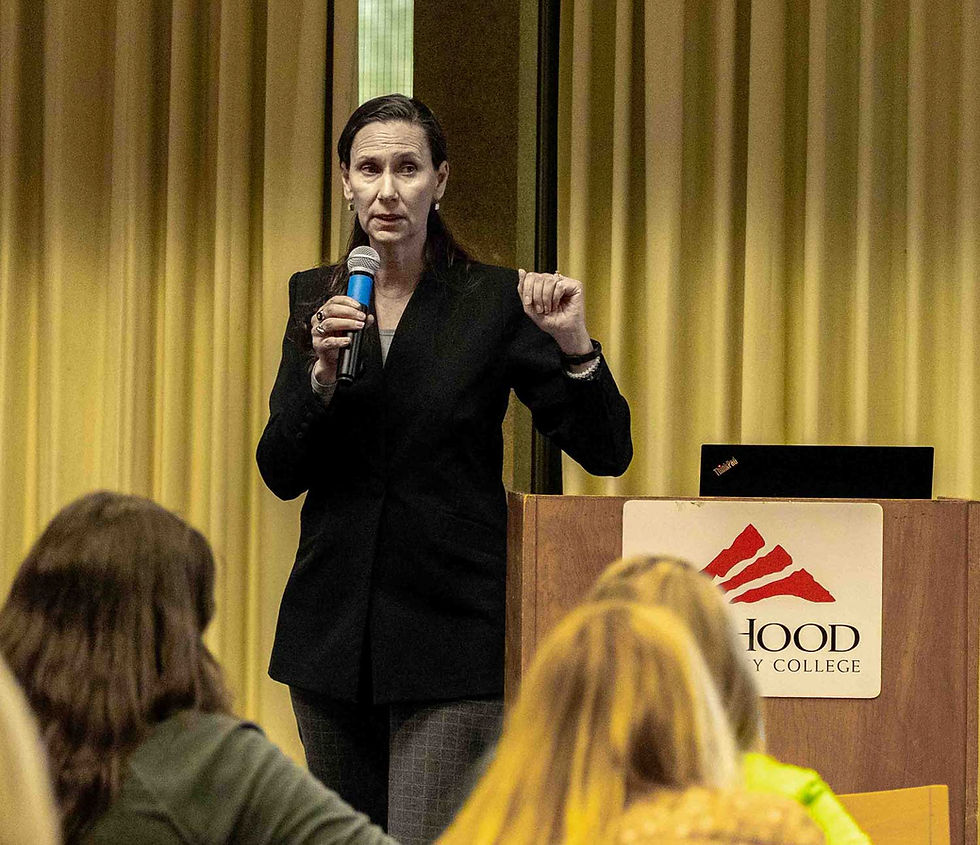
When Mt. Hood Community College President Lisa Skari sat down with The Advocate, she kept things simple.
“Call me Lisa.”
It is a small thing, but an intentional one — a genuine effort to break down hierarchy and keep conversations open.
“I think we have a role beyond just educating students,” Skari said. “Students can get skills without sitting in a classroom. How do we remain relevant, and what’s our role and our space as Mount Hood Community College in this community.”
She spoke candidly about the realities of leading a community college: the constant uncertainty of budget management and the broader challenges facing higher education. At the time, what she shared felt like context. Now, with current and looming budget cuts expected to total in the millions, it feels more immediate. “Funding has always been kind of an issue, right?” she said. “There’s always been that dance, and you’re pulled around by where the state is at the time and how much money they have to give.”
Throughout the conversation, Skari spoke openly — and at times informally — about the college, its students and the responsibility of leading an institution built around access and opportunity.
Recent decisions at MHCC, including program changes and position reductions, have made visceral the kinds of trade-offs Skari described, where institutional priorities, financial realities and student needs do not always align.
Skari has described that tension repeatedly, framing leadership not as a series of clear answers, but as a process of navigating competing priorities, often without certainty. She has emphasized that while many parts of the college serve students, not all functions can be sustained equally during times of financial constraint. That reality is a difficult pill to swallow, particularly for students experiencing the impact firsthand.
In conversations across campus and among The Advocate staff this week, one feeling surfaced again and again: The changes announced so far do not feel right, and the uncertainty of what comes next is frightening. Programs and services students rely on are shifting or shutting down entirely. Tuition is increasing. Beloved and respected staff members are being laid off. The effects are immediate and deeply felt in classrooms, support spaces and across the community.
At the same time, there has been acknowledgment of the position Skari and other college leaders are in. The responsibility of making decisions like these — without clear or easy answers and with consequences affecting students, staff and programs alike — is not one any of them would want to carry.
It is a weight Skari herself has acknowledged publicly — speaking candidly about the difficulty of the decisions, apologizing to those affected and making clear that the choices are not made lightly. That tone reflects not only institutional responsibility, but the personal weight of carrying those decisions.
The tension between frustration and understanding sits at the center of this moment. It reflects not just disagreement over specific decisions, but the broader reality of how institutions operate under pressure.
For Skari, that means focusing on what she describes as “mission-critical” work — areas that directly support student learning, access and long-term success. Even then, the cost remains high.
“Even when a decision is made for the long-term sustainability of the college,” she said, “it doesn’t mean that it doesn’t come at a cost and a loss.”
It also means continued conversation. “We are committed to sustained communications around this,” Skari said at a budget forum held April 1 at MHCC.
She has emphasized the importance of transparency and engagement, encouraging students and staff to stay informed and share their perspectives. Campus forums and Board of Education meetings provide opportunities for students to participate and voice concerns as decisions continue to take shape. College leadership has also encouraged community members to reach out directly.
None of this resolves the tension. The uncertainty Skari described in earlier conversations is no longer abstract — it is unfolding in real time. But one consistent thread remains: The conversation between students and leadership is still open.
In a moment like this, that may matter more than ever.
Comments